Showing posts with label Leipzig Campaign 1813. Show all posts

Friday, March 29, 2019

Swedish Soldiers of the Napoleonic Wars (Part V) - The Infantry Battalion and the use of Jaegers

The Swedish Napoleonic Army organisation in short (very short!)

The core of the Swedish army of the Napoleonic Wars was a standing army that during peace time saw only limited time of drill and other actual time serving in the army. These are the alloted (indelta) units. What they lacked in training were to some extent made up with experience as many had served for 10+ years and loyalty to the unit as they served together with men from their own neighbourhood. The rest of the army was made up from enlisted (värvade) units. During the war there were also some militia being used from the vargering and the lantvärn. For a more in-depth look you might want to read this article by Magnus Olofsson.

Regimental Jaegers of the Upland Regiment
(note the black belts and green plume denoting their jaeger capacity).
Picture from the Anno 1808 - Uplands Regemente
re-enactment group, please see more of them HERE

The Battalion and the use of Jaegers 

The battalion, usually some 500-600 men strong, was the basic tactical infantry unit in the Swedish army. Most battalions had four companies with two platoons per company. Some of the enlisted units were organized differently. From 1806 the infantry was to be deployed in two ranks but this was supposedly changed back to three ranks in 1813.

For skirmishing action the Swedish army had some, often enlisted, units of "pure" jaeger like the Wermlands Fältjägare. However, from 1805, what was more prominent was the use of Line Infantry Jaegers or regementsjägare ("regimental jaeger"). The term regimental jaeger is a bit confusing as they were formed from their parent battalions but as mentioned below they were sometimes merged into bigger units and used at a higher organisational level.

Perry Miniatures Swedish infantry in 28mm (SWED 4).
Various regiments. Note the green plumes on the regimental jaegers.
Also, their (partly) blacked belts. I would
paint all belts of the jaegers black however.
Perry Miniatures Wermland Jaegers (SWED 12), an enlisted unit.

The introduction of regimental jaegers followed Sweden’s war against Russia 1788-1790. The efficiency of light troops in broken terrain resulted in an increased Swedish focus on light infantry action. Not only were all line infantry to be trained in fighting in dispersed order but also every Swedish battalion was to have a platoon of jaegers selected from suitable men of the battalion. Originally, each infantry battalion was to form a 53 men strong jaeger platoon (one officer, two NCO’s, two corporals and 48 privates) but in 1806 this was doubled to a 106 men strong jaeger company per battalion. In the 1813, the number of jaeger per battalion was again lowered to 58 officers and men (one officer, two NCO’s, four corporals, one bugler and 50 privates).

The employment of these Line Infantry Regimental Jaegers varied; sometimes they were used as skirmishers for their parent battalion, sometimes merged to a regimental jaeger company or battalion, but most often they were removed from their parent battalions and formed into a light infantry battalion held at brigade level.

The Regimental Jaeger Uniform 

As noted above the Swedish Line Infantry Jaegers ("regementsjägare") wore the same uniform as their parent unit. However, their leather belts were often black instead of white and they wore a green plume. Jaegers of non Line Infantry units often had a similar change compared to their parent regiment uniform aswell.

Earlier posts on Swedish Soldiers of the Napoleonic Wars

Part I - Swedish Soldiers of the Napoleonic Wars - an Overview
Part II - Swedish Soldiers of the Napoleonic Wars - a Modeling Tutorial for 1806-1809
Part III - Swedish Soldiers of the Napoleonic Wars - Uniform Colours and a Painted Example
Part IV - The Swedish Soldier's Greatcoat - a Tutorial

Sunday, February 4, 2018

Swedish Soldiers of the Napoleonic Wars (Part IV) - Modelling a Greatcoat for 28mm

Happy days ahead as Perry Miniatures are about to release Swedish miniatures for the Napoleonic era. They will do an excellent job of them I'm sure. So less need to convert your own Swedish miniatures, thankfully.

For an overview of the Swedish uniform of the Napoleonic era please have a look HERE.

I don't know if the Perry's Swedish range will cover soldiers in greatcoats though. Ever since before the days of Charles XII and the Carolean soldiers the Swedes used a simple cape in bad weather. It was not before 1806 a greatcoat called kapott was introduced. It had not only sleeves but also a falling collar that reached the elbows. It was in use for the rest of the Napoleonic War.

A m/1806 kapott from the Army Museum's collections.
This particular example is not full size and is
intended as a "blueprint" sent to the regiments.
A Knötel drawing illustrating the Swedish greatcoat or kapott.
Also note the "Mid War" uniforms.

As the Siege of Stralsund 1807 aswell as the war in Finland 1808-1809 both includes fighting in bad weather conditions, including snow in winter, one might want to include some soldiers wearing their greatcoat. Fortunately Perry Miniatures can help us yet again. For Swedish napoleonic infantry in greatcoats we have used ACW49 Early Federal Militia in shakos, overcoats and full kit, from the Perry American Civil War range.

We have used British Marine Heads from Brigade Games. These should recieve a special mention as they were great to use for converting Swedish line infantry for most of the war. You can for instance combine them with Perry Miniatures dismounted dragoon bodies to create the Early War (m/1802) uniform as Mikael at the Dalauppror did as seen HERE. But with Perry Miniatures soon releasing Swedish napoleonics the need for coverting your own miniatures will hopefully disapear all together eventually.


Below are some pictures that hopefully show the process of making a Swedish greatcoat using the miniatures above. I added a collar of greenstuff, together with the bag and the cupper bowl. Please note that for my example I cut and filed the lower legs on the ACW miniature to give the impression of gaiters.


Monday, January 9, 2017

Napoleonic Saxons in 28mm - a Line Battalion

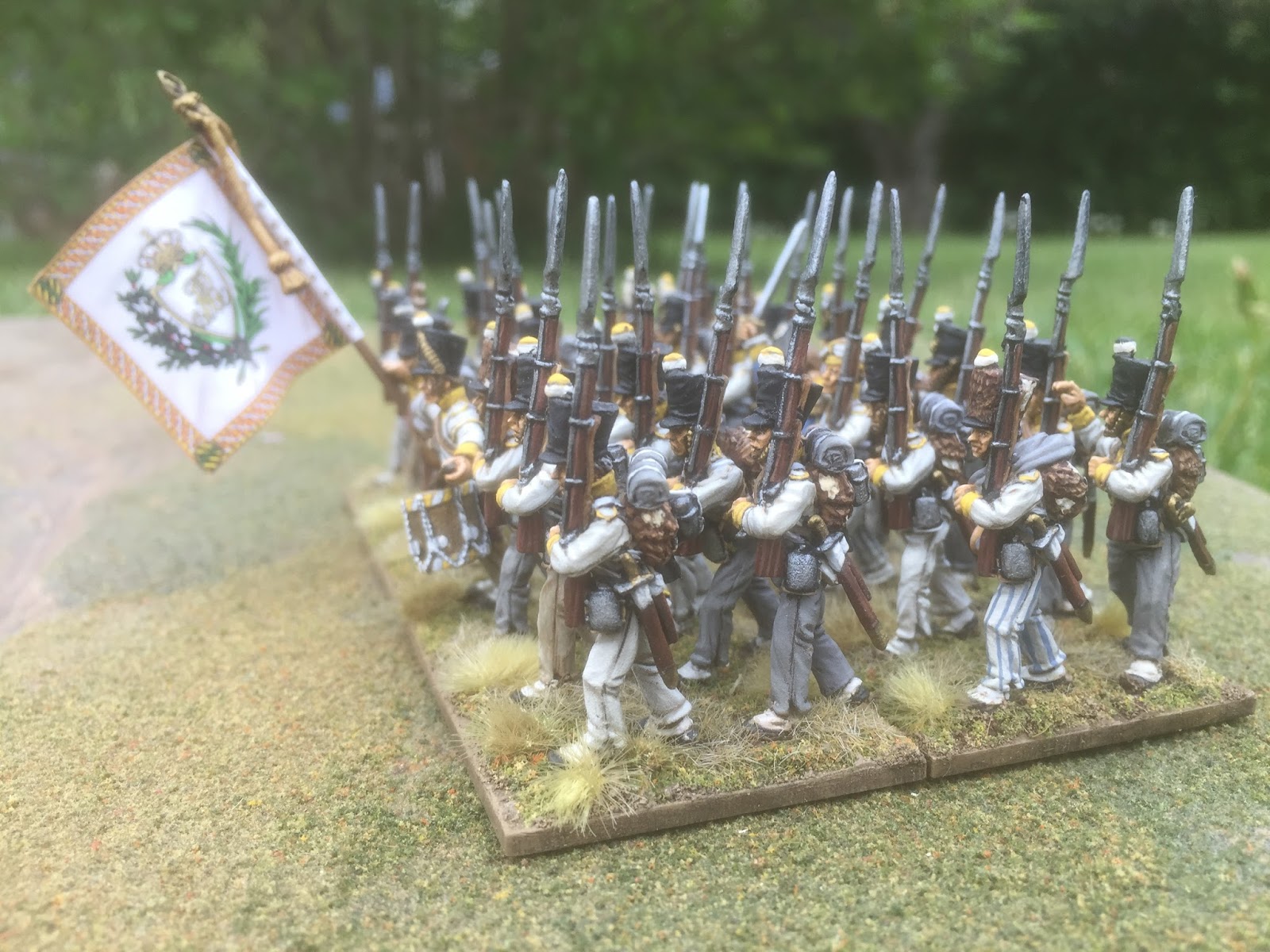
A Saxon battalion from the Prinz Maximilian regiment

Time for some more painted miniatures. This time a break from the World War 2 theme with a Saxon battalion from the Prinz Maximilian regiment. They are truly excellent sculpts of Paul Hicks from Westphalia Miniatures, painted by Andreas. 


Sunday, May 29, 2016

Swedish Soldiers of the Napoleonic Wars (Part I) - an Overview

A Guide to the Swedish Napoleonic Uniform

With Sharpe Practice 2 now released its time to get our Napoleonic skirmish wargaming going again. Together with Dalauppror (please have a look here) there will, of course, be a Swedish theme. Our main focus will be on the Siege of Stralsund in 1807 and the Finnish War 1808-1809 where Sweden fought the French and the Russians respectively.

As our gaming will feature Swedish soldiers of the Napoleonic Wars we thought we should post some information on the look and colours of the Swedish soldiers of that era, as that information isn't as widely known.

Before posting for instance a tutorial on how to convert a miniature into wearing a Swedish Mid Uniform of 1806 - for use in the campaigns of Germany (Pommerania), Norway and Finland - it might be useful to provide some uniform context. So here is Part I on Swedish Napoleonic Soldiers that focus on the cut of the uniform and the other equipment worn by the soldiers.

The Swedish line infantry uniform of the Napoleonic Wars (1803-1815) went through quite a few changes in the field - and even more on paper. It is complicated to establish what specific uniform that was worn in the field by a certain regiment at a certain time. Also, we are no true experts but this is our best effort (that we would happily adjust if needed). That said, to simplify, the Swedish Napoleonic line infantry uniform can be divided into three main categories. These categories don't cover all aspects, neither all regiments, but you can sometime benefit from doing 28mm miniatures instead of a re-enactment full size uniform...
- the Early Uniform - with plastron ("front panels")
- the Mid Uniform - single row of buttons, including both the modified 1806-version and the new grey enhetsuniform ("unity uniform") of 1807
- the Late Uniform - double row of buttons

Despite that new uniform regulations were being issued uniforms were sometimes to be worn out before being replaced and also logistics troubles and scarce resources in general made older uniforms being used in later stages of the war.

It should therefor be stressed that although for instance the Finland War of 1808-1809 could be described as a Mid War conflict where you might expect to see the then latest uniform (i e the unity uniform of 1807) it was instead more common to see the modified version of 1806 or the Early Uniform of 1802.


The Early Uniform

The Swedish uniform of the 18th century preserved the look of the Caroleans of Sweden's time as a major European power. After a change of style during the rule of Gustav III (1771-1792) the Early War uniform - first introduced in 1792 - presented a new cut for the Napoleonic Age.

It should again be stressed that although here described as an Early Uniform it lived on with many regiments through out the war in Finland.

The Early Uniform is recogniced by its plastron, a "breastplate" of front panels on the uniform's chest. Gaiters went above the knee. The round tall hat that - more or less unchanged - would stay on for many years, was close to corsican style with its brim turned up on one side. Another item that would stay on was the black neck-cloth that was worn around the neck, under the jacket's collar.

The short sword were in use and hung from a leather waist belt. Instead of a backback a single strap satchel of cowhide was worn together with a bulkruka, a copper bowl for water.

An Early m/1792 uniform, of the Uppland regiment.

An Early Uniform. A m/1802 of Hälsinge regiment
(from the Army Museum - the Digitalt Museum web page)


A side view of an Early Uniform jacket
(again from the Army Museum - the Digitalt Museum web page)

The Mid Uniform

The Mid Uniform is a case of two in one: the 1806 modified version of the Early Uniform jacket and the new so called unity uniform of 1807. The former was simply the older (often blue) jacket re-sewn into a new style. The latter was a concept of trying to replace all the variedly coloured uniforms with a single uniform of the same colour - grey with blue facings - for all line regiments. In both cases the plastron of the Early Uniform was no more and the Mid Uniform instead had a single row of buttons. The grey unity uniform failed to be properly implemented, atleast during the Finish War 1808-1809, and the modified 1806-version (together with the still used Early Uniform) seem to have been the norm.

Gaiters were, at least for many regiments, shortened to below the knee. The black neck-cloth was still used. A yellow and blue striped, wide belt of cloth was introduced and the short sword droped, leaving the soldiers to rely on the bayonett. With the unity uniform, the leather belts for the cartidge box etc were regulated to be black instead of the normal white for regular line infantry. The Early Uniform hat was still in use. It is uncertain to what extent the regulated round patch or cockade on the front of the hat with a coloured cross was actually worn in the field. It was supposed to be differently coloured depending on the regiment. The single strap satchel and copper bowl were both still in use (the satchel was single straped until 1811 when it was ordered to be modified into a knapsack with two straps).

The Mid Uniforms - the unity uniform in grey and the modified version of 1806
in blue, the latter probably of the Södermanland regiment. The officers in the
picture wear long tailed surtouts and white scarfs around their left arm
- a sign of loyalty to the king since Gustav III's coup of 1772.
The Early Uniform compared to the Mid Uniform
A Mid Uniform jacket, from the Jönköping regiment worn at the
battle of Ratan in 1809 (from the Army Museum - the Digitalt Museum website)
A rear view of a Mid Uniform
(The Army Museum - the Digitalt Museum website)

A single strap satchel m/1757 made of calfskin.
(The Army Museum - the Digitalt Museum website)
A bulkruka, a copper bowl. This example might be from a later date.
(from the Bohusläns museum - the Digitalt Museum website)

The Late Uniform

A soldier in the the Late Uniform - introduced in 1810 and as seen during the campaigns of 1813-1814 - has a somewhat different look compared to the Early and Mid Uniforms. The jacket had double rows of buttons. The cuffs got cuff-flaps with three buttons. Also, trousers were worn over the gaiters and decorated with "knots" and sometimes also a stripe along the outseams. The single strap satchel had finally been replaced by (or made into) a real backpack with the great coat straped on top. The copper bowl was still there though, and carried on the outside of the backpack. The hat of the Early Uniform was also still there. Some units might have taken initiative to upgrade the hat to a more modern shako. However, looking at Ljunggren's contemporary illustrations the old style of hat still seem to have been the norm and the shako was not implemented for real until 1815. The distinctive blue and yellow belt was in use.

A Ljunggren contemporary illustration of a Late Uniform.
Note the bulkruka - the copper bowl (pictured somewhat big).
A Late Uniform as pictured by Knötel.
A rear view of another Late Uniform.
This might not be a line infantry uniform because of the epaulettes
but still gives a good example of the cut of the Late uniform.
(The Army Museum - the Digitalt Museum website)
Uniforms of Västgöta-Dals regiment, of particular interest here is the
1815 uniform - a "later than late uniform" using our classification.
Very similar to what we call the Late Uniform though, but it has the 1815 shako.


Sunday, December 29, 2013

AAR: If you go down to the woods today - Napoleonics of 1813 in 28mm

A Song of Drums and Shakos battle report depicting an ambush in the forests of Saxony 1813


Introduction

Quite some time ago we played some more Song of Drums and Shakos (SDS) and now, finaly we hade time to do a write up. SDS is a Napoleonic skirmish game from Ganesha Games by Sergio Laliscia. An introduction to the game can be found in our first AAR, found here.
For this game we didn't use any specific scenario but rather played a standard game with ordinary victory conditions of trying to break the opposing force.

Our game featured a small Swedish patrol marching down a forest road somewhere in Saxony 1813 as a group of French soldiers lies in wait. This time we gave the Swedes a tough nut to crack as the French were skilled veterans of many campaigns (we used the stats of Young Guard for the French). The Swedes had to count on their larger numbers and the use of their cavalry to prevail. 
As usual we played the game with 28mm miniatures on a 120x120cm (48x48”) board using the measurements intended for 40mm miniatures.

The opposing forces

The Swedish Patrol
1 Senior NCO (aka Officer)
6 Line Infantrymen
1 Hussar NCO
2 Hussars 

The Swedish Patrol


The French in Ambush
1 Veteran Officer
1 Veteran NCO
5 Veteran Infantrymen


The French Veterans


The initial set up


The deployment


The game

It started with the Swedish patrol coming marching down the road, spotting French shakos amongs the trees. The Swedish Senior NCO called for his men to move forward as the French took up positions, one group entering a small grove. 


The Swedish patrol advance down the road.
As the Swedes advanced their Senior NCO failed to keep up, apparently to busy urging the others on. The smaller of the two French groups advanced within short range of their muskets firing at the Mörner's hussars galloping towards them. The first shots caused two of the hussar horses to bolt, losing some momentum. However, no serious wounds were inflicted. The third and last Frenchman on that side of the road, Soldat Petit, fired his rifle but his shot ricocheted of a tree and piered his own Officers hat across the road, momentarily distracting the rest of the French.


The French brace for the Swedish charge.

Getting close the Swedes launched their attack. All across the line however they failed to get stuck in properly as they lost their footing, got out of breath or any other excuse for a bad performance. The first to reach the French lines were the Hussar NCO who only just made contact but then didn't have it in him to land a single blow. In return the French veterans followed their drill from countless battles and one Frenchman lunged his bayonet into the side of the Hussar NCO's horse as the other impaled the hapless hussar with his bayonette, killing him. Over at the grove the French officer easily killed the first Swede to reach him as one of his soldiers fired from amongst the trees knocking an advancing Swedish soldier to the ground. 


The Swedish attack fails to make true impact.

The close combat got underway for real as the two remaining hussars got their horses under control and charged. The momentum was already lost however and only one of the Frenchmen were knocked to the ground, getting on his feet again only moments later. In the grove the Officer was attacked again, this time by two Swedes. As an seasoned swordsman he parried the attacks and killed a Swedish soldier in return. 

Mörners' hussars attack the French.

In a swirling melee of cavalry and infantry the hussars got the upper hand as one hussar knocked a Frenchman down and the other trampled him to death beneath the hooves of his horse. In the grove things where not going the Swedes way as they stumbled trying to attack the French Officer, giving the initiative to the French. The French immediately returned the favor however as Soldat Petit again failed to attack properly and only moved up to the hussars, causing his countryman to doubt his true allegiance.

With combat all across the line and more Swedes arriving the Swedes doubled their efforts and managed to strike the French officer to the ground. Before the Swedes could capitalize on the situation the French carabinier attacked killing a Swede giving the officer just enough time to get on his feet. Back on his feet the French officer continued his excellent swordsmanship cutting down yet another (his third!) bayonet wielding Swede. No doubt inspired by his leader yet another French soldier killed his Swedish adversary.


Swedes bite the dust. (Out of focus to save us the gory details, surely...)
With their numbers low the Swedes morale faltered. Two of the Swedish infantry broke away from the French and of of the Hussars surrendered, presenting his sabre to the French.

The Swedish Senior NCO realised all was lost and called for his men to retreat, leaving the field to the French.


"Rädde sig den som kan!" The Swedes flee from the victorious French.

The French had won!

Conclusion

A quite straight forward game but great fun none the less. The better quality and combat skill of the French really paid off. As the initial Swedish attack faultered in an uncordinated manner they failed to get their numbers to bear at the critical moment. Only some bad luck on the French side then kept the French from having a walk in the park victory (as oppostite to a real fight in the woods).

Monday, September 30, 2013

AAR: A Romantic Visit Cut Short - a Napoleonic Skirmish in 1813

A Song of Drums and Shakos Battle Report


Introduction

As promised here are yet another After Action Report of Song of Drums and Shakos (SDS), a Napoleonic skirmish game from Ganesha Games by Sergio Laliscia. An introduction to the game can be found in our first AAR, found here.

For this game we used one of the scenarios in the supplement rule book: ”Reinforcements”. The original scenario sees the attackers trying to take and hold a redoubt as reinforcements arrive trying to help out the defenders in the redoubt. 

For our game we used a different setting. It is 1813 and vast armies maneuver close to each other as the French advance towards Berlin is stalling. A Prussian officer, taking a few soldiers with him, is visiting a certain local "lady" as a French reconnaissance force arrive on the scene. As shots start to fly Swedish troops nearby are alerted and race to help their assaulted Prussian allies.

The scenario stipulates a small starting force of Prussians deployed in the redoubt (or in our case: the enclosed yard). The attacking French deploy on any one table edge. The Swedish soldiers arrive randomly - both regarding numbers and entry point. The French win if at any time the yard is without defenders and at least a single Frenchman is within the walls. Apart from that normal victory conditions apply.

We played the game with 28mm miniatures (all but a few bits being from Perry Miniatures) on a 120x120cm (48x48”) board using the measurements intended for 40mm miniatures.


The opposing forces


The Prussian Defenders 

1 Line Infantry Officer
1 Drummer
5 Line Infantry Musketeers

The Swedish Reinforcements

1 Line Infantry NCO
6 Line Infantrymen
1 Hussar NCO
2 Hussars


The Prussian defenders (to the left) with the Swedish reinforcements (to the right)

The French Reconnaissance Force

1 Line Infantry Officer
1 Drummer
2 Line Infantry NCOs (Grenadier and Voltiguer respectively)
1 Sapper

3 Line Infantry (Grenadiers)
6 Line Infantry (Voltiguers)
6 Veteran Line Infantry (Voltiguers)

The French Reconnaissance Force

The initial set up
A 4x4 table

The deployment

The initial deployment zones. The defender's reinforcements will later arrive from
a random table edge numbered 1-4 or, on a roll of 5 or 6, on a table edge of the defender's choice. 

The game


It was an early morning after a late night…

As the morning mist started to lift the lone Prussian sentry spotted the shakos of a french reconnaissance party among the trees. The Prussians sounded the alarm and scrambled from their nights rest to get in order. Moments later their officer appeared from the house, pulling his pants up and his uniform jacket still unbuttoned.

The Prussian officer, his romantic visit cut short.

The French approached from two directions. Two groups of voltiguers - with an officer, NCO and drummer - came from the forested hill. A group of experienced veterans led the attack while the rest prepared to open fire.

At the same time a group of French grenadiers - with a NCO and sapper - attacked from another direction, towards a small opening in the stone wall enclosing the yard.


French grenadiers and a sapper approach the Prussian right...

...while one of the groups of voltiguers on the Prussian left open fire.
The first shots rang out as the voltiguers in the tree line fired. The Prussians kept their heads down, taking cover behind a wagon parked in the yard, while the veteran voltigures ran across the open ground towards the wall. Their NCO, Sergeant le Coq, however, apparently suffering from a bad hangover dragged his feet and did not manage to keep up with his men.

The leading group of voltiguers arrive at the wall,
outrunning both their NCO and the other voltiguers still in the tree line.
The voltiguer veterans now in a good position by the wall started to pour fire at close range at the Prussians covering behind the wagon. Meanwhile the french grenadiers was also closing in, arriving at the opening in the wall, in the flank of the hard pressed Prussians. Even though the Prussians - with a lot of luck – so far had managed to avoid heavy casualties their position was now very dire indeed.

The French grenadiers come to join the party.
Luckily for the Prussians their Swedish allies had sentries nearby. Responding already to the first shots being fired they started to arrive on the scene, behind the French grenadiers.

The first Swedish soldiers arrive on the scene.
As the Swedish infantrymen advanced on the French the grenadiers cooly turned and fired, killing the leading Swedish soldiers.

But the Prussian luck continued as a patrol of Swedish Mörner Hussars that was returning to their  lines from a night scouting mission now came galloping down the road towards the farm house.

 Swedish Mörner Hussars comes to the Prussians' aid.
The tables now had turned as more Swedish infantry poured on to the field while the Swedish hussars closed in. The French grenadiers was now in a very bad spot – some had already emptied their muskets at the approaching Swedish infantrymen while others had charged into the yard at the Prussians. The remaining grenadiers were in the open as the hussars was almost upon them. A frightening prospect for any infantry soldier.

The French grenadiers, quite surprisingly, proved to be more than a match for the hussars. Even though they were caught in the open by charging cavalry they managed to slow the Swedes down. Instead of being wiped out at an instant it all turned into a swirling melee by the corner of the stone wall where the Mörner hussars hacked down with their sabres at the French grenadiers at their feet with little or no result.

The French grenadiers proving to be hard as nails!
The Swedish hussars fail to break the French left flank.
In a final effort to clear the yard of Prussians the French intensified their efforts and the voltiguers begun to jump over the wall, attacking the Prussians with their bayonets.

The Swedish reinforcements were not far behind however and followed the French example, resulting in a large hand to hand combat in the yard. The French sapper distinguished himself as he again and again held his own against multiple enemies before he was finally brought down.

The grizzled French sapper fight against the Swedes.
Casualties started to mount on both sides. The French grenadiers were fighting a losing battle against the Swedish hussars but in a heroic effort managed to drag one of the horsemen to the ground.

In the yard both sides lost men. The allied superiority in numbers within the walls started to make a difference and it looked liked it might go bad for the French. The group of French voltiguers, the first to open fire, was only all to slowly advancing towards the farm - much needed further forward.

The second group of French voltiguers finally advance on the farm. But is it too little to late?

Fierce hand to hand combat in the yard.

Just when it looked like the French were going to be able to get more men into hand to hand combat the last of the grenadiers holding the French left flank against the Swedish hussars fell. The Swedish Mörner hussars saw the French officer exposed and spurred their horses forward.

All was not lost for the French officer however as he had one of his trusted NCO:s close at hand. With some quick thinking Sergeant le Coq could lead the French to intercept the threat against their officer. Sadly,  the sergeant continued his poor performance from earlier, and did nothing. This lack of action caught the rest of the French flat footed and gave the Swedish hussars the lone French officer served on a plate.

This time around the Swedish hussars showed what they can do to infantry in the open. They unceremoniously cut the French officer down, killing him.

The French officer is ridden down while Sergeant le Coq is looking the other way...
With their numbers running low and their officer killed many of the French turned and fled. Sergeant le Coq running faster than every one else... The yard was firmly in the hands of the Allies. The Prussian officer would now be able to make a less hasty and more worthy exit (if there is such a thing) from his lady.

The Allies - Prussian and Swedes - had won!


Conclusion

It was a fun game with some unexpected results and turnovers along the way.

The Allies had some real luck with the timing of their reinforcements. The infantry did not only arrive early but all of them also came from the best (closest!) table edge. Had that not happened it would have been a different game entirely. The Swedish cavalry also arrived at the worst possible moment for the French, a moment where they were spread out over the battlefield with some entering the yard and others still quite a long way from the farm. That left a only a handful of French grenadiers to try to hold the Swedish Mörner hussars.

As a result of us being somewhat rusty on the rules we made a mistake in the ensuing cavalry vs infantry combat giving the grenadiers a far better chance of survival than they were supposed to have. Well, as it turned out it gave us a more balanced game over all... When it was time for the French officer to fight the cavalry we used the rules properly - much to the dismay of a certain French officer who quickly found himself very dead!

As an end note, the French were bound to lose regardless as they had the NCO, Sergeant le Coq on their side. He cost the French numerous turnovers and failed to do anything properly - apart from running away at the end that is.