A Song of Drums and Shakos Battle Report and
a short presentation of the game itself.
Introduction
It was time for our first "propper" game of Song of Drums and Shakos (SDS), a Napoleonic skirmish game from Ganesha Games by Sergio Laliscia.
A normal game features soldiers in two "squads" - selected at a given point cost - set against each other. The game mechanism evolves around being able to activate your soldiers to perform actions (like shot, move or fight in close combat). An action is successful if the player can beat the soldiers Quality (on average 4+ or 3+ if an Officer is close by) on a D6.
The player can chose to go for up three actions (rolling three dice) with each soldier per turn. However, if any single soldier fail two (or more) actions the player turn ends and it is your opponents turn - with any soldiers on your squad yet not activated losing their turn. So, the player can chose to play safe by trying one, or maybe two actions per soldier per turn, thereby reducing or eliminating the possibility of a turn over, or going for three actions risking more but at the same time getting more out of his soldiers each turn. In effect soldiers of better quality (French Old Guard are Quality 2+) will get more done each turn compared to troops of poor quality.
There are modifications to this. For example, as mentioned above, soldiers that are close to their officer gets +1 to their activation roll. Also, soldiers in base to base contact can make any of several different Group Actions like Group Move and Volley Fire making them more efficient.
In short, for close combat and ranged combat both players roll a D6 and add their Combat value (normally 2) and some modifiers for range, cover, weapon etc. If you beat the opponents score the soldier will be knocked to the ground or pushed back. If you beat the score by doubling it the soldier is removed as a casualty. For ranged combat only the target soldier can be harmed of course.
There are rules for morale and other things aswell.
Overall, the rules are well written and structured and gives an appealing first impression.
For this game we didn't use any of the scenarios but instead went for a straight skirmish battle having the two normal sized squads advancing on each other for a fight to the finish.
The fight was between a Prussian patrol and some French stragglers after the battle of Leipzig 1813. The Prussians were mainly normal line infantry (musketeers) while the French consisted of light infantry (légère) of some elite status.
The opposing forces
French Light Infantry (Légère)
1 Light Infantry Officer
1 Light Infantry NCO
1 Drummer
2 Light Infantry Chasseur
2 Light Infantry Voltiguer
1 Light Infantry Carabiner
Prussian Line Infantry (Musketeers)
1 Line Infantry Officer
1 Line Infantry NCO
1 Drummer
8 Line Infantry Musketeer
1 Lieb Hussar (elite)
The initial set up
 |
| The table. |
The deployment
 |
| The squads enter the table. |
The game
The game began with the two squads advancing towards the middle.
The French squad sent the Voltiguer marksmen with their yellow and green markings together with the NCO up the slope to their right while the Officer together with the Drummer led the Chasseurs and the Carabinier towards the central hill.
Meanwhile the Prussian Officer with the Drummer led a majority of the Musketeers up the slope as the NCO led the remaining three Musketeers towards the central hill. To their right an elite Hussar of the Prussian Death Head's Hussars advanced out of sight to the French.
 |
| The Prussians advance in two groups against the distant French. |
In the beginning the progress was slow and sporadic as the Officers on both sides failed to coordinate the soldiers into managable groups. It was not long, however, before the Lieb Hussar stayed his horse in possition behind the hill waiting for the Prussian musketeers to catch up.
 |
| The brave Prussian hussar. Hiding behind the hill... |
 |
| The Prussians advance to the beat of the drum. |
The French Voltiguer marksmen took position behind a tree and waited for the Prussian advance. As they could make out the Prussians over the fence one of the Voltiguers fired the first shot of the skirmish but the bullet failed to find its mark.
 |
| Bang! |
The Prussians continued to advance, keeping their muskets silent, as the French Voltiguers under the guidance of the NCO fired again and again, speedily reloading after each shot. So far the range and cover was to much to inflict any damage however.
The French advance towards the central hill was hesitant at best with the Officer apparently having no influence over his men what so ever. The Prussians with their NCO on the other side of the hill faired only little better.
Up on the slope the Prussian Musketeers jumped the first fence blocking their way moving up to the next. The French Voltiguers kept up a high rate of fire (probably four shots a minute!) still not managing to inflict any real damage on the advancing Prussians. The French so called marksmen not having a very good day...
 |
| The Voltiguers fire. Again. Much ado about nothing. |
As the opposing forces closed in a Prussian Musketeer moved past the central hill and fired at close range at the leading French Chasseur, knocking the frenchman to the ground but not killing him. This move was countered as another French Chasseur opened fire making the Prussian fall to the ground - in a very vulnerable position to a French bayonet assault... The French lost the initiative however and failed to take advantage of the opportunity. The remaining Prussians instead managed to advance as their knocked down comrade rose to his feet. White black powder smoke spread at the foot of the hill as the the two squads fired at each other before the Prussians charged.
 |
| Sporadic fire as the soldiers close in... |
 |
| ...entering fierce close combat. |
Up on the slope, as their Officer called "fire!", the five Prussians fired a massive volley killing one of the Voltiguers in cover behind the tree before they quickly reloaded and was prepared to fire yet again.
 |
| "Fire!" The Prussian volley kills a Voltiguer. |
Down by the hill a swirling melee took place where both sides tried to gain the upper hand. A French Chasseur and a Prussian Musketeer got killed before the Prussian NCO charged with is bayonet. Much to the dismay of the Prussians the Hussar failed to time his attack around the hill and did not manage to close the full distance to the French.
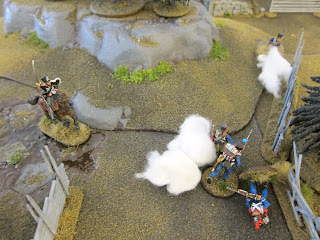 |
| The Hussar charges! |
Realising the danger the French Officer took a few steps forward and fired his pistol at the charging Hussar. Failing to kill him the shot only managed to get the Hussar's horse to rear back a few steps. Getting the momentum again the Hussar charged the Officer and a intense sword fight begun.
 |
| En garde! |
At the same time, up on the slope, the French were fighting a loosing battle. Yet another volley killed the last Voltiguer leaving the NCO alone. The NCO realising he could do nothing to shift the Prussians from their firing line behind the fence fell back out of sight down the slope.
 |
|
| Yet another Prussian volley. Yet another French Voltiguer bites the dust. |
|
The clash of the titans continued as the sabres of the Officer and Hussar met, the Hussar having the upper hand. Finally the Hussar found an opening in the Officer's defence and brought down his blade, killing the French Officer. Not only having lost their Officer but also half of their number the French realised the day was lost.
The Prussians had won!
 |
| The French Officer goes down. |
|
|
 |
"Sauve qui peut!"
|
Conclusion
A great game! Song of Drums and Shakos proved to play smoothly and give some tactical challenges at the same time. Clearly, we still have alot to learn when it comes to mastering the finer aspects of the game and making the right tactical choises. Also, it took us awhile before we got into the flow of using Group Actions to great effect. However, it was great fun and we are eager to get some more games played.
.JPG)
.JPG)